Sleep, Sleep Apnea and Testosterone: How Bad Nights Lower Your Levels
How short sleep and sleep apnea lower testosterone, what the studies actually measured, why CPAP alone rarely raises T, and why apnea matters before TRT.
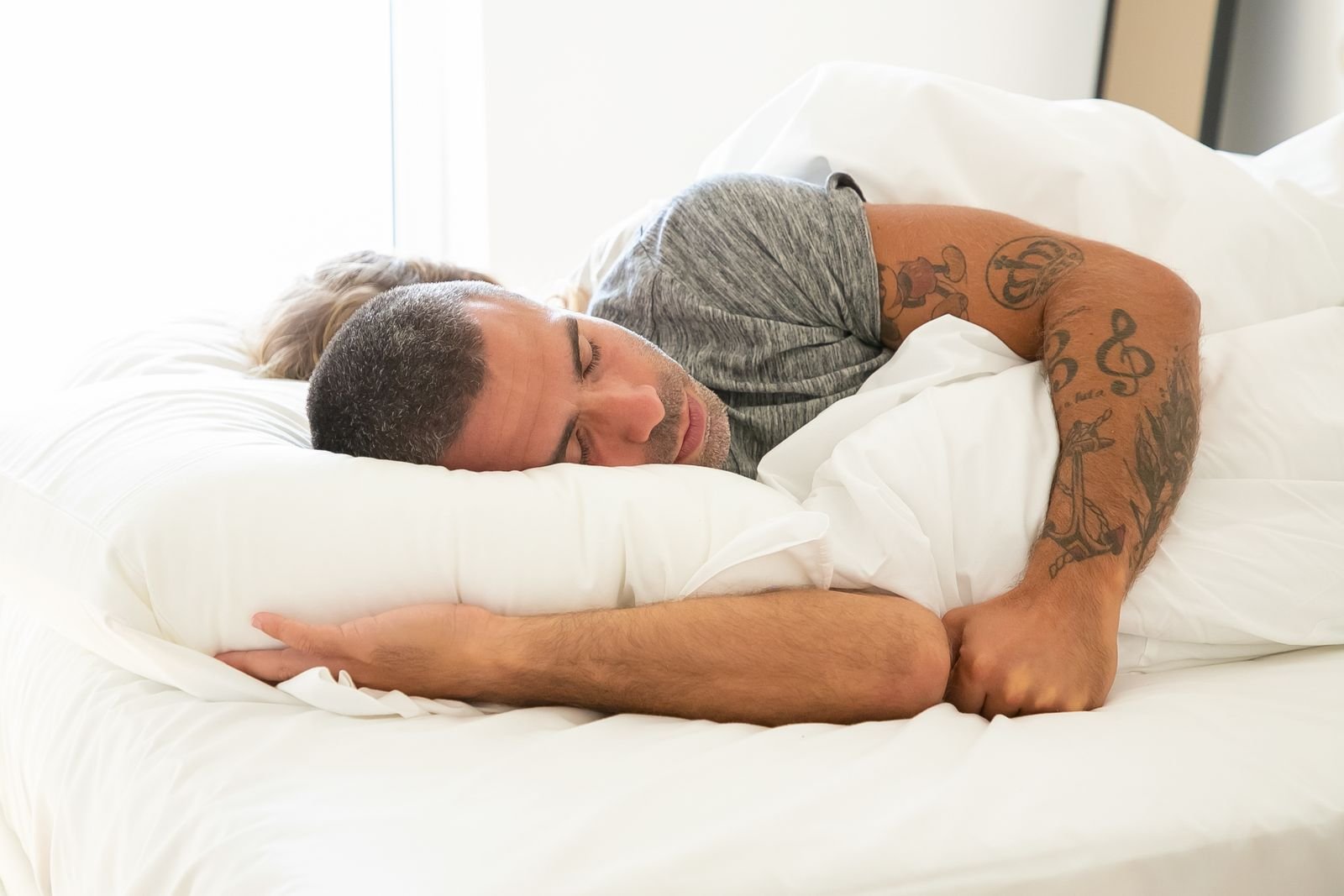
Sleep and testosterone are tightly linked because much of the daily rise in testosterone happens while you sleep: levels start climbing at sleep onset and need roughly three hours of unbroken sleep to peak. In a JAMA study, healthy young men limited to five hours in bed for a week had daytime testosterone 10 to 15% lower than when fully rested. Obstructive sleep apnea is also associated with lower testosterone, most clearly when it is severe, although much of that link runs through excess weight.
This matters in two ways. A low testosterone result after weeks of poor sleep may partly reflect the sleep, not a hormone disorder. And if you have untreated sleep apnea, that changes the safety picture for testosterone therapy, which can temporarily worsen apnea and raise hematocrit.
Key takeaways
- Eight nights of five hours in bed lowered daytime testosterone about 10 to 15% in ten young men, comparable to several years of age-related decline.
- Broken sleep blunts the overnight rise even if total time in bed is normal.
- In a meta-analysis of 18 studies, severe sleep apnea was significantly linked to lower testosterone; mild and moderate apnea were not.
- CPAP did not significantly raise testosterone in a meta-analysis of 12 studies. Weight loss is the change most consistently tied to higher testosterone in men with apnea.
- The Endocrine Society lists untreated severe sleep apnea as a reason not to start testosterone therapy.
How sleep builds your morning testosterone
Testosterone is released in pulses, about every 90 minutes, following pulses of LH from the pituitary. Superimposed on those pulses is a daily rhythm: highest on waking, lowest at the end of the day. The overnight rise is tied to sleep itself, not just the time on the clock.
A 2014 review by Wittert summarizes the sleep lab findings, much of it from Luboshitzky and colleagues:
- Testosterone begins rising at sleep onset, peaks around the first REM period in young men and stays elevated until waking.
- Peak production occurs during the first three hours of uninterrupted sleep, and at least three hours of sleep with normal structure appears to be needed for the rise.
- A longer delay before the first REM period means a slower rise.
- Fragmented sleep throughout the night prevents the increase.
The practical point: eight hours in bed with repeated awakenings, from apnea, a young child or alcohol, may do less for testosterone than six solid hours. This is also why the timing of your blood test matters; see why your testosterone test has to be done in the morning.
Sleep and testosterone: what the sleep restriction studies show
The most cited study is Leproult and Van Cauter (2011, JAMA). Ten healthy men (mean age 24, mean BMI 23.5) spent a week at home on eight-hour nights, then three lab nights with ten hours in bed, then eight lab nights limited to five hours in bed (12:30 a.m. to 5:30 a.m.).
| Measure | Rested | After a week of 5-hour nights |
|---|---|---|
| Actual sleep per night | 8 h 55 min | 4 h 48 min |
| Testosterone, 8 a.m. to 10 p.m. | 18.4 nmol/L (about 531 ng/dL) | 16.5 nmol/L (about 476 ng/dL), roughly 10% lower |
| Testosterone, 2 p.m. to 10 p.m. | 17.9 nmol/L (about 516 ng/dL) | 15.5 nmol/L (about 447 ng/dL), roughly 13% lower |
| Vigor score | 28 after the first restricted night | 19 after the seventh |
Cortisol did not change, and the drop in testosterone tracked with lower vigor. The authors noted that normal aging lowers testosterone by about 1 to 2% per year, so a week of short sleep had an effect comparable to, or larger than, several years of aging.
How strong is this evidence?
Weaker than the headlines suggest. The Leproult study had ten young, lean men, called itself a small convenience sample, and did not measure SHBG. Other studies are mixed. Wittert’s review notes that five nights of restriction with sleep in the first half of the night produced no significant testosterone change, although SHBG fell (Reynolds et al., 2012), while limiting sleep to 4.5 hours was linked to lower morning testosterone (Schmid et al., 2012). Total sleep deprivation lowers testosterone. Wittert concluded that evidence for a direct effect of sleep restriction on testosterone, independent of SHBG or other conditions, is equivocal.
A fair reading: severe or sustained short sleep can lower testosterone measurably, and that effect is large enough to push a borderline result under a cutoff. It is unlikely to be the whole explanation for a man whose levels are far below normal.
Sleep apnea and testosterone
Obstructive sleep apnea (OSA) means the airway repeatedly collapses during sleep, cutting airflow and oxygen and fragmenting sleep. It is common: Wittert cites a São Paulo study in which 41% of men had OSA, and an Adelaide figure of 53% of men aged 40 and over.
The best summary of the link is a 2022 meta-analysis in Andrology (Su et al.) of 18 studies and 1,823 men:
- Men with OSA had significantly lower testosterone overall (standardized mean difference -0.76), and the association held after adjusting for age and BMI (-0.8).
- By severity, only severe OSA was significantly associated with lower testosterone (-1.21). The associations for mild (-0.58) and moderate (-0.94) OSA did not reach significance.
Individual studies show how much weight matters. In 1,312 men aged 65 and over (Barrett-Connor et al., 2008, as summarized by Wittert), lower testosterone went with worse apnea measures, but adjusting for BMI or waist size largely erased the association. In 89 severely obese men (Hammoud et al., 2011), apnea severity was inversely related to free testosterone. Wittert’s conclusion is that OSA appears to have little direct effect on testosterone after accounting for age and obesity, but may act indirectly by worsening obesity. Weight gain and low testosterone feed each other, which is covered in belly fat and low testosterone.
Does treating sleep apnea raise testosterone?
Usually not by much, at least not with CPAP alone. Cignarelli et al. (2019, Frontiers in Endocrinology) pooled 12 studies (10 prospective cohorts and 2 randomized trials) covering 388 men with a weighted mean age of 52.6 and mean BMI of 32.5. CPAP was associated with a mean change in total testosterone of 1.08 nmol/L (about 31 ng/dL), which was not statistically significant. Results were similar in men who were hypogonadal at baseline, with a non-significant trend toward a rise.
The authors point out that CPAP does not reduce body weight, and suggest that obesity is the more likely driver of low testosterone in men with apnea. Weight loss, by contrast, lowers apnea severity and raises total and free testosterone, roughly in proportion to the amount lost, according to the studies they and Wittert cite. CPAP is prescribed to treat the apnea itself; it should not be expected to fix a low testosterone level on its own. If weight is part of the picture, our weight program is one place to start that conversation with a licensed provider.
Why sleep apnea matters before testosterone therapy
The relationship runs both ways. Testosterone therapy can affect breathing during sleep, and apnea is one of the factors guidelines check before and during treatment.
- Before starting. The Endocrine Society’s 2018 guideline lists untreated severe obstructive sleep apnea as a reason not to start testosterone. Cignarelli et al. describe it as a contraindication because of a time-limited worsening of the sleep disorder.
- What the trial showed. In a placebo-controlled trial in obese men with severe OSA (Hoyos et al., 2012, summarized by Wittert), injectable testosterone undecanoate mildly worsened the oxygen desaturation index at 7 weeks, but not at 18 weeks.
- During treatment. When hematocrit rises above 54% on therapy, the Endocrine Society calls for stopping testosterone and evaluating for hypoxia and sleep apnea, since low oxygen at night can push red cell production higher. See TRT and hematocrit.
High-dose testosterone and anabolic steroid misuse have also been associated with shorter sleep, insomnia and more awakenings. At the other end, in older men lower testosterone was linked to lower sleep efficiency, more nighttime awakenings and less deep sleep, so poor sleep can be both a cause and a symptom.
What your numbers mean if you sleep badly
A general guide to reading a testosterone result in light of sleep. Lab reference ranges vary; discuss your results with a licensed provider.
| Situation | What studies suggest | Reasonable next step |
|---|---|---|
| Borderline result (roughly 250 to 350 ng/dL) after weeks of short sleep | Short sleep lowered daytime T about 10 to 15% in a small study | Repeat the morning, fasting test after a stretch of normal sleep |
| Low result plus loud snoring, witnessed pauses or daytime sleepiness | Severe OSA is linked to lower T; untreated severe OSA argues against starting TRT | Ask about a sleep study before treatment decisions |
| Low result, OSA on CPAP, BMI over 30 | CPAP alone rarely raises T; weight loss is linked to higher T | Address weight and confirm with repeat testing, LH and FSH |
| Clearly low result (for example under 200 ng/dL) despite good sleep | Sleep is unlikely to explain a deficit this large | Full evaluation, including LH, FSH and causes |
| On TRT with rising hematocrit | Guidelines evaluate for sleep apnea and hypoxia above 54% | Ask about apnea screening |
For the diagnostic cutoffs themselves, see what counts as low testosterone.
Questions to ask your provider
- Could my recent sleep explain a borderline result, and should we repeat the test?
- Do my symptoms or weight warrant a sleep study before any testosterone treatment?
- If I have sleep apnea, how does that change which options make sense for me?
- If I start therapy, how should we watch for worsening apnea or rising hematocrit?
- Is weight loss likely to help my numbers, and by how much in my situation?
Frequently asked questions
How much does lack of sleep lower testosterone?
In Leproult and Van Cauter 2011, eight nights of five hours in bed lowered daytime testosterone about 10 to 15% in healthy young men. Other studies found smaller or no effects, so the size likely depends on how severe and how long the restriction is.
Does sleep apnea cause low testosterone?
Severe sleep apnea is associated with lower testosterone, but much of the link is explained by obesity, which drives both. Reviews describe any direct effect of apnea itself as small or uncertain.
Does CPAP increase testosterone?
In a 2019 meta-analysis of 12 studies, CPAP did not significantly change total testosterone. CPAP treats the apnea; weight loss is the change most consistently linked to higher testosterone in men with apnea.
Can TRT make sleep apnea worse?
It can, at least temporarily. In obese men with severe apnea, testosterone mildly worsened oxygen desaturation at 7 weeks but not at 18 weeks, and the Endocrine Society advises against starting testosterone in men with untreated severe apnea.
If you suspect sleep is part of your low-energy, low-drive picture, a licensed provider from our clinical partner, The Tide Clinic, can review your symptoms and labs in a free consultation and help decide what to check first. Learn more about the men’s testosterone program.
References
- Leproult R, Van Cauter E. Effect of 1 week of sleep restriction on testosterone levels in young healthy men. JAMA. 2011;305(21):2173-2174. https://doi.org/10.1001/jama.2011.710
- Wittert G. The relationship between sleep disorders and testosterone in men. Asian J Androl. 2014;16(2):262-265. https://doi.org/10.4103/1008-682X.122586
- Su L, Meng YH, Zhang SZ, et al. Association between obstructive sleep apnea and male serum testosterone: A systematic review and meta-analysis. Andrology. 2022;10(2):223-231. https://doi.org/10.1111/andr.13111
- Cignarelli A, Castellana M, Castellana G, et al. Effects of CPAP on Testosterone Levels in Patients With Obstructive Sleep Apnea: A Meta-Analysis Study. Front Endocrinol (Lausanne). 2019;10:551. https://doi.org/10.3389/fendo.2019.00551
- Bhasin S, Brito JP, Cunningham GR, et al. Testosterone Therapy in Men With Hypogonadism: An Endocrine Society Clinical Practice Guideline. J Clin Endocrinol Metab. 2018;103(5):1715-1744. https://doi.org/10.1210/jc.2018-00229
This article is for education only and is not medical advice. It does not replace an evaluation by a licensed provider, who can tell you whether any test or treatment is appropriate for you. Enclomiphene is not FDA-approved. Compounded medications are not FDA-reviewed for safety, effectiveness, or quality. Results vary.